
The key point: We never see your card details
When you pay with a credit or debit card on Right Spot, you are redirected to PayPal’s secure checkout page. Your card information is entered directly on PayPal’s website-not on ours. This is not just a policy; it is how the entire payment system is designed. Here is what happens when you pay with a card through PayPal:- You click to pay and are redirected to PayPal’s official website (paypal.com)
- You enter your card details directly into PayPal’s secure form
- PayPal encrypts and processes the payment with your card issuer
- PayPal sends Right Spot only a confirmation that payment was successful
- You are redirected back to Right Spot to see your order confirmation
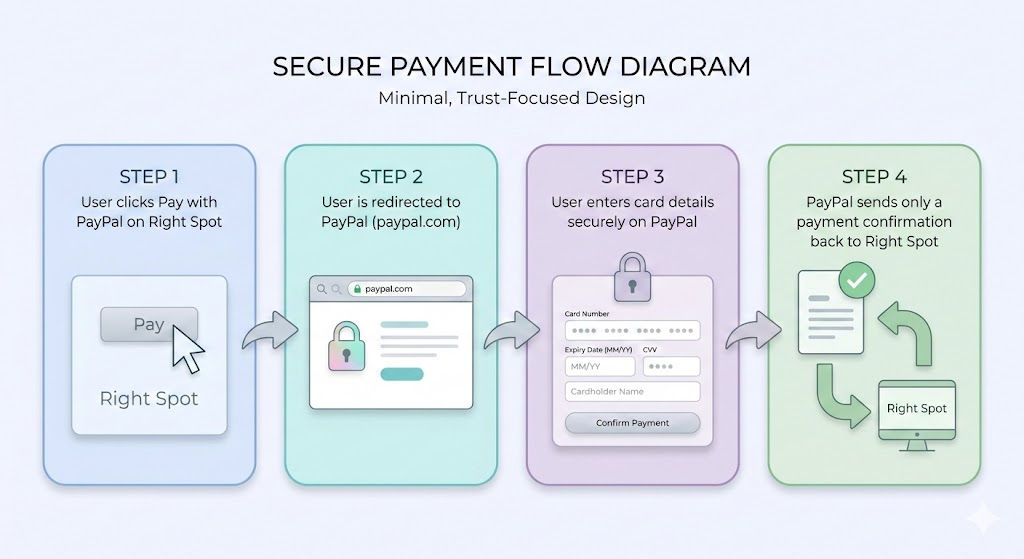
How PayPal protects your card information
PayPal is one of the world’s largest payment processors, handling over $1.36 trillion in payment volume annually. When you pay through PayPal-whether using your PayPal balance or a card-your financial information stays with PayPal.What PayPal’s merchant protection means for you
According to PayPal’s official documentation, merchants (like Right Spot) receive only:- A transaction ID confirming the payment
- The payment amount
- Your PayPal email address (if you used a PayPal account)
- Basic transaction status information
- Your full card number
- Your card expiration date
- Your card security code (CVV/CVC)
- Your billing address details
- Your bank account information
- Your PayPal password
Official documentation and proof
PayPal publishes extensive documentation about their security practices. Here are official resources you can review: PayPal Security Center: https://www.paypal.com/us/security - PayPal’s official security information page explaining their protection measures. PayPal Privacy Policy: https://www.paypal.com/privacy-center - Details what information PayPal shares with merchants (which does not include your card details). How PayPal Works for Buyers: https://www.paypal.com/us/webapps/mpp/how-paypal-works - Official explanation of how your information stays protected when you pay. From PayPal’s security documentation:“When you pay with PayPal, your financial information is never shared with the seller.”This statement comes directly from PayPal and applies to all transactions, including card payments made through PayPal checkout.
Technical explanation: Why we cannot access your card
The payment flow is designed at a technical level to prevent merchants from accessing card data: Redirect-based checkout: When you click “Pay with PayPal,” your browser navigates to paypal.com. You are no longer on our website. The form you fill out is PayPal’s form, hosted on PayPal’s servers, secured by PayPal’s SSL certificate. No card data transmission to merchants: PayPal’s API for merchants uses tokens and transaction IDs. There is no API endpoint that would allow us to request your card details, even if we wanted to. PayPal simply does not offer that capability. PCI DSS compliance architecture: PayPal is PCI DSS Level 1 certified—the highest level of payment card industry security certification. Part of how they maintain this certification is by architecturally preventing card data from reaching merchants.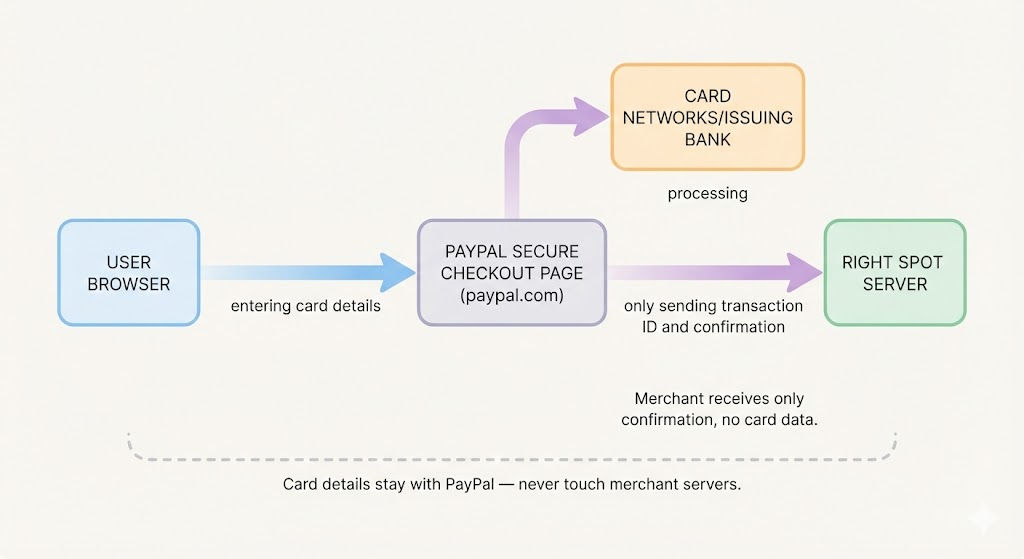
How each payment method protects you
Credit and debit cards (via PayPal)
When you pay with a card through PayPal:- You enter card details on PayPal’s secure website
- PayPal encrypts and processes the payment
- Right Spot receives only a transaction confirmation
- Your card details never touch our systems
PayPal balance
When you pay with your PayPal balance:- You authorize payment directly on PayPal’s website
- Your PayPal credentials never leave PayPal
- We receive only confirmation of payment
UPI (India)
UPI payments are processed through UPI Gateway:- You authorize in your UPI app using your PIN
- Your UPI PIN never leaves your device
- We receive only confirmation of the transfer
Litecoin
Cryptocurrency payments work on the blockchain:- You send LTC from your wallet using your private keys
- Your wallet credentials never leave your device
- We see only the incoming transaction
What this means in practice
If Right Spot were ever breached
In the hypothetical scenario of a security breach at Right Spot, your payment credentials would remain completely safe because:- We do not have your card numbers—PayPal does
- We do not have your PayPal password—PayPal does
- We do not have your UPI PIN—your bank does
- We do not have your crypto keys—your wallet does
You can verify this yourself
When you reach the payment step:- Look at your browser’s address bar-you will see “paypal.com,” not our domain
- The SSL certificate (padlock icon) shows PayPal’s certificate, not ours
- Any card form you fill out is on PayPal’s page
Additional security measures
Beyond payment architecture, Right Spot implements: HTTPS everywhere: All connections to our site use modern TLS encryption. Secure session handling: Login sessions use HttpOnly cookies that cannot be accessed by JavaScript. Fraud monitoring: We watch for suspicious activity patterns. Discord OAuth security: We never see your Discord password—Discord handles authentication.Common questions
Do you store my card for future purchases?
Do you store my card for future purchases?
No. We do not store card details because we never receive them. Each purchase requires entering your card information on PayPal again. This is by design—there is no card data on our end to store.
Why can't you just show me a card form on your site?
Why can't you just show me a card form on your site?
Displaying a card form on our site would require us to handle card data, which would create security risks and compliance obligations. By redirecting to PayPal, your card data stays in PayPal’s secure environment. This is the safer approach.
Is PayPal safe to use?
Is PayPal safe to use?
PayPal has been processing payments since 1998 and handles transactions for over 400 million active accounts worldwide. They are PCI DSS Level 1 certified and invest heavily in security. They also offer buyer protection if something goes wrong with a purchase.
What if I don't have a PayPal account?
What if I don't have a PayPal account?
You do not need a PayPal account to pay with a card. On PayPal’s checkout page, there is an option to pay with a debit or credit card without creating an account. Your card is still processed securely through PayPal.
Can I see proof that you don't receive card data?
Can I see proof that you don't receive card data?
Yes. When you check out, open your browser’s developer tools (F12) and go to the Network tab. You will see that when you enter card details, the data is sent to paypal.com domains, not to our servers. The only data we receive from PayPal is a transaction confirmation.
Summary
Your payment security on Right Spot is guaranteed by the fact that we use PayPal as our payment gateway. Your card information goes directly to PayPal, is processed by PayPal, and stays with PayPal. We receive only confirmation that you paid—nothing more. This is not a promise or a policy. It is how the payment system is built. There is no mechanism for us to access your card details even if we wanted to.This concludes the security documentation. Return to Documentation home or explore other sections using the sidebar navigation.